
Food Safety Screen — Soil Test
- Regular price
- RM 250.00 MYR
- Sale price
- RM 250.00 MYR
- Regular price
-
RM 0.00 MYR
🌴 Tropical Optimized — Formulated for Malaysian weather.
Note: Product efficacy optimized for Tropical Climates (24-35°C). Performance in temperate winters may vary.
- 🌴 General Maintenance:
- Supports Malaysian garden health.
Share
Food Safety
Screen
You can't see heavy metals. You can't taste pesticide residues. But they end up in your food. If you're growing edibles, know your soil is safe — not just fertile.
Clearance Report
The threats you
can't detect yourself
Healthy-looking soil can still pose serious food safety risks. The only way to know is to test.
Heavy Metals
Lead, arsenic, cadmium, and mercury can accumulate in vegetables and leafy greens. They're odourless, tasteless, and invisible — but pose serious long-term health risks, especially for children.
Unknown Land History
Rented land, reclaimed plots, and urban gardens carry the legacy of what came before. Testing is the only way to be certain — and to grow with genuine peace of mind.
Every parameter, explained
Two test groups — fertility and safety — combined into one comprehensive screen.
Everything included,
nothing extra to buy
One price. One package. Every deliverable included.
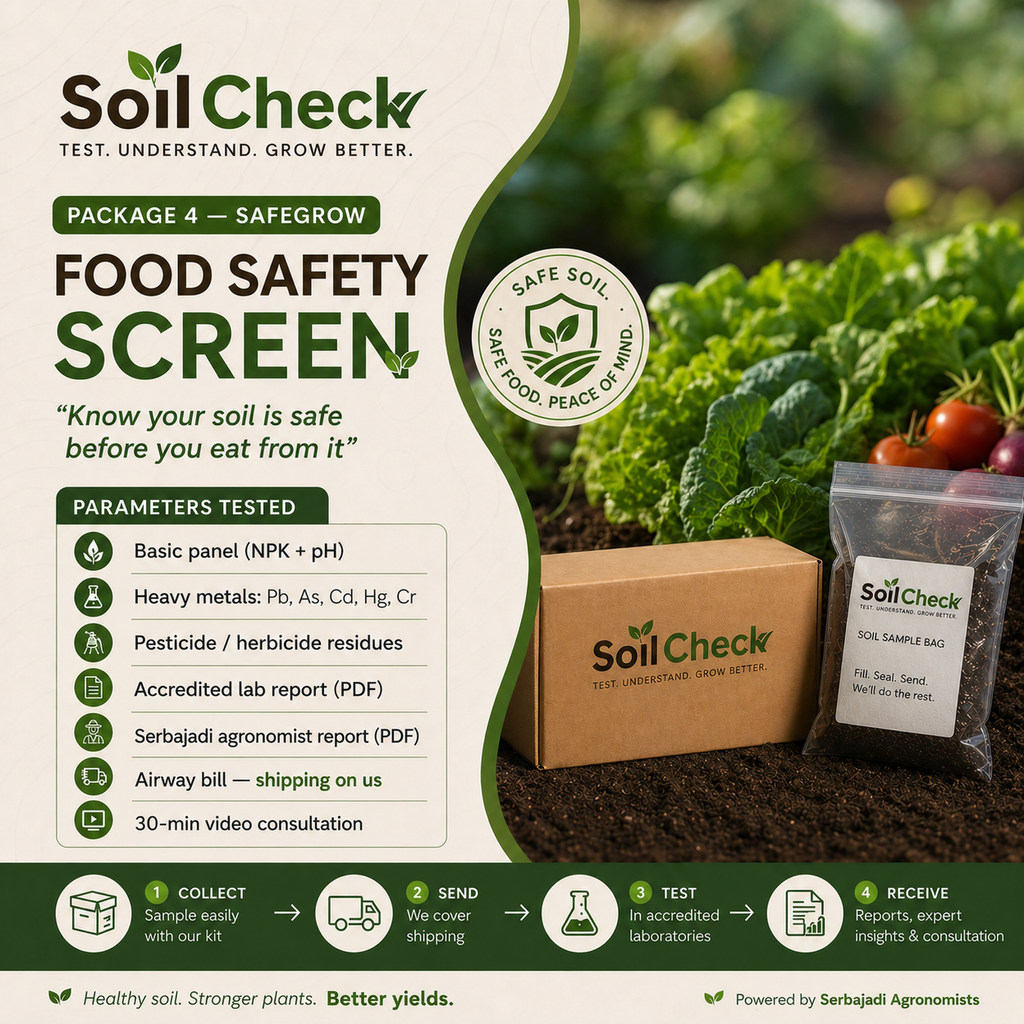
Accredited Lab Report
Official PDF from our MS ISO/IEC 17025 accredited lab partner with exact measurements for all parameters.
Serbajadi Agronomist Report
Plain-language commentary from our agronomist team — what the results mean, what to do next, and which amendments to consider.
Airway Bill — Shipping on Us
We email you a prepaid airway bill. Drop off your sample at any courier point — no delivery cost on your end.
30-Min Video Consultation
A live call with a Serbajadi agronomist who reads your specific report with you and answers your questions directly.
From your garden to
your safety clearance
Five steps. No lab experience needed.
Order your package
Complete your order below. We confirm and email you a prepaid shipping airway bill.
Collect your sample
Fill a zip lock bag with about 400g of soil.
Ship it to us
Attach the airway bill and drop off at any courier point or arrange for collection. Shipping is completely on us.
Lab analysis
Your sample is screened for heavy metals, pesticide residues, and basic fertility at our accredited lab.
Reports + consultation
Both PDF reports emailed, then a 30-min call with our agronomist to walk through your results.
Test your soil if you are…
The Food Safety Screen is for anyone growing food and wanting certainty, not assumptions.
Growing vegetables, herbs, or fruit on land you don't own or have recently acquired
Using land that was previously used for agriculture, construction, or industry
In an urban area near old buildings, busy roads, or manufacturing facilities
Starting a community garden on reclaimed or donated land
Concerned about your children or family regularly consuming home-grown produce
Frequently asked
Everything you need to know before ordering your Food Safety Screen.
What heavy metals are tested and why?
What happens if heavy metals are detected?
How do pesticide residues get into soil?
How do I collect my soil sample?
How long does it take?
Tests you can trust
Our partner lab holds full MS ISO/IEC 17025 accreditation — the international benchmark for testing laboratory competence.
Know your soil is safe.
7–10 working days · Accredited lab · Shipping on us
❓ Frequently Asked Questions
Is Food Safety Screen — Soil Test suitable for Malaysian weather?
Yes. This product is specifically formulated and tested for Malaysian tropical conditions (24-35°C).
Is this safe for edible plants?
Universal Safety Protocol: 'Organic' refers to material origin, not guaranteed safety. For ALL products (Organic & Inorganic), we recommend a 7-day harvest interval (safe withholding period) before consuming treated edibles, and thorough washing of produce.
Is this safe for pets and children?
Store Safely: Treat all gardening supplies with caution. Store in a cool, dry place strictly out of reach of children and pets to prevent accidental ingestion.
What is the return policy?
Serbajadi offers a 30-Day Satisfaction Guarantee. Contact our KL support team if unsatisfied.
🚚 Shipping & Guarantee
- ✅ Free Shipping: Orders >RM200 (Klang Valley)
- ✅ Fast Processing: Ships from KL within 24 hours
- ✅ Trusted: Malaysian gardeners' choice since 1988